Posts Editor

SIP Trunking Scalability

SIP Trunking Scalability: Add Channels in Minutes, Not Weeks

SIP Trunking Scalability: Add Channels in Minutes, Not Weeks | NetViaVoice ๐Ÿ“ž +1 201 979 3825  |  ๐Ÿ‡ต๐Ÿ‡ฐ +92 333 5908806  |  โœ‰๏ธ support@netviavoice.com NV NetViaVoice SIP Trunking & VoIP Experts Our Services ๐Ÿ“ž Call Us ๐Ÿ’ฌ WhatsApp Scalability Deep-Dive 2026 SIP Trunking Scalability:Add Channels in Minutes, Not Weeks Discover how modern SIP Trunking eliminates the slow, expensive process of adding phone capacity โ€” and lets your business grow at the speed of demand. ๐Ÿš€ Get Started Free ๐Ÿ’ฌ WhatsApp Us ๐Ÿ“‹ Article Summary SIP Trunking transforms the way businesses scale their phone systems โ€” what once required weeks of waiting, technician visits, and thousands in hardware costs can now be done in minutes from a web portal. This in-depth guide breaks down exactly how SIP Trunking scalability works, compares it against traditional phone lines, covers real-world use cases, and shows you the true cost difference. Whether you are a startup expecting rapid growth or an established business with seasonal peaks, SIP Trunking is the only communication infrastructure built to scale as fast as you do. ๐Ÿ“‘ Table of Contents Why Scalability Is the #1 Problem with Traditional Phone Systems How SIP Trunking Scalability Actually Works Speed Comparison: Traditional vs SIP Trunking Real-World Scaling Scenarios for Businesses The Real Cost of Scaling Traditional vs SIP Bandwidth & Infrastructure Considerations How to Scale Your SIP Channels Step-by-Step Scalability Checklist: What to Look for in a SIP Provider Frequently Asked Questions Related Articles 1. Why Scalability Is the #1 Problem with Traditional Phone Systems Every growing business eventually runs into the same painful wall: you need more phone capacity โ€” fast โ€” and your legacy system makes that nearly impossible. Traditional PBX phone systems were designed in an era when adding capacity meant physical hardware, copper wires, and scheduled technician visits. The process was slow by design, not by accident. When a traditional business wanted to add even a single new phone line, it triggered a cascade of steps: contacting the carrier, placing an order, waiting for provisioning, scheduling an installation visit, purchasing additional hardware, and finally configuring the system. In many cases this process took two to four weeks โ€” and cost hundreds of dollars per line. For modern businesses โ€” especially those experiencing rapid growth, seasonal demand spikes, or sudden expansion into new markets โ€” this inflexibility is not just inconvenient, it is a direct threat to revenue. Missed calls mean missed sales. Overloaded lines mean frustrated customers. Scaling too slowly means your competitors move faster. SIP Trunking was built specifically to solve this problem. To understand the full picture of what SIP is and how it operates, read our foundational guide: What Is SIP? The Complete Explanation. 5 minAverage Channel Add Time (SIP) 3โ€“4 wkAverage Wait Time (Traditional) $0Hardware Cost to Scale SIP โˆžSimultaneous Channels Available Scale Your Phone System Today โ€” Zero Hardware Required NetViaVoice lets you add SIP channels instantly from your dashboard. Talk to our team and get set up in hours, not weeks. ๐Ÿ“ž +1 201 979 3825 ๐Ÿ’ฌ WhatsApp Us โœ‰๏ธ Email Us 2. How SIP Trunking Scalability Actually Works SIP Trunking delivers phone services over your existing internet connection using the Session Initiation Protocol โ€” a standards-based signaling framework that manages voice, video, and messaging sessions digitally. Because there is no physical infrastructure to provision, scaling is a purely software-defined operation. Think of SIP channels like lanes on a highway. Each channel handles one simultaneous call. When you need more lanes, you simply request them through your provider’s portal โ€” no digging up roads, no installing new asphalt. The new lanes appear immediately because they are virtual constructs, not physical objects. โš™๏ธ Under the Hood: How a New SIP Channel Is Added You log into your NetViaVoice management portal and select “Add Channels” The system allocates new virtual SIP trunks on the provider’s network instantly Your SIP-enabled PBX or IP phone system detects the new capacity automatically New DID (Direct Inward Dial) numbers can be assigned to the channel in the same session Call routing rules and IVR configurations are applied without service interruption Your team can begin using the new channels within minutes of the request This contrasts sharply with traditional PSTN lines where provisioning involves physical switching at the carrier’s central office, installation at your premises, and hardware updates to your PBX. Even the simplest analog line addition was a multi-department coordination exercise spanning days or weeks. 3. Speed Comparison: Traditional Phone Lines vs SIP Trunking The most striking difference between the two systems is time. Let’s walk through a direct timeline comparison for a business that needs to add 10 new phone channels to handle a product launch campaign. โฑ Traditional PBX โ€” Adding 10 Lines 1 Day 1: Contact Carrier Submit line order request to your telecom provider. Wait for order confirmation (often 24โ€“48 hours). 2 Days 3โ€“7: Order Processing Carrier processes the request, checks line availability at your exchange, and schedules provisioning. 3 Days 8โ€“14: Hardware Procurement Order additional PBX cards or trunk interfaces. Wait for delivery and installation window. 4 Days 15โ€“21: Technician Visit Schedule and await on-site visit for physical installation and cabling. Often requires downtime. 5 Days 22โ€“28: Testing & Go-Live Configure, test for line quality issues, resolve faults. Typical total elapsed time: 3โ€“4 weeks. โšก SIP Trunking โ€” Adding 10 Channels 1 Minute 1: Log Into Portal Open the NetViaVoice management dashboard. Navigate to channel management. 2 Minute 2: Select & Confirm Choose number of channels to add and confirm. Instant provisioning begins automatically. 3 Minute 3โ€“5: Channels Live New channels are active. Assign numbers, configure routing rules. Team begins taking calls immediately. ๐Ÿ“Š Time to Add 10 Phone Channels: Traditional vs SIP Trunking Traditional PSTN (Days) 21โ€“28 Days ISDN BRI/PRI (Days) 14โ€“18 Days Hosted PBX (Days) 4โ€“7 Days SIP Trunking (Minutes) < 5 Min 4. Real-World Scaling Scenarios for Businesses SIP Trunking’s instant scalability delivers measurable value in a wide range of real-world situations. Here are the most common scenarios where the

SIP Trunking Scalability: Add Channels in Minutes, Not Weeks Read More ยป

SIP Trunking Cost Savings

SIP Trunking Cost Savings: How Much Can You Save?

SIP Trunking Cost Savings: How Much Can You Save? | Netvia Voice SIP Trunking Cost Savings: How Much Can You Save? ๐Ÿ’ฐ Summary: Businesses save between 40% and 65% on monthly phone bills by switching from PRI/analog lines to SIP trunking. A typical 12-channel setup saves $6,000โ€“$9,000 annually. This guide breaks down real savings, ROI calculations, hidden cost eliminations, and industry-specific examples โ€” plus a savings calculator table to estimate your own reduction. ๐Ÿ“‘ Table of Contents 1. Why SIP Trunking Cuts Costs 2. SIP vs PRI: Cost Comparison Table 3. Monthly & Annual Savings Chart 4. Hidden Costs You Eliminate 5. ROI & Payback Period 6. Industry-Specific Savings 7. Factors That Influence Savings 8. Frequently Asked Questions For decades, businesses accepted the high costs of traditional PRI (Primary Rate Interface) and analog phone lines as unavoidable. But with SIP trunking, those costs can be cut dramatically โ€” often by more than half. The question isnโ€™t if you can save money, but how much and how quickly you can see returns. This comprehensive analysis quantifies the savings across different business sizes, call volumes, and geographic footprints. Unlike legacy phone services that bundle channels in fixed increments (typically 23 channels per PRI) with per-minute usage fees and expensive overages, SIP trunking allows you to pay only for the concurrent call paths you actually use. You can add or remove channels in single increments, choose unlimited calling plans, and eliminate separate long-distance charges. Many businesses reduce their monthly telecom spend from thousands to a few hundred dollars. Letโ€™s dive into the numbers. We’ll compare SIP trunking against traditional PRI and analog lines using real market rates, show you visual savings charts, and even provide a simple way to estimate your own potential savings. Whether you run a retail chain, a law firm, a call center, or a multi-location enterprise, youโ€™ll find actionable data here. ๐Ÿ“ž Ready to calculate your exact savings? Our experts are here. ๐Ÿ“ž +1 201 979 3825 ๐Ÿ’ฌ WhatsApp +92 333 5908806 โœ‰๏ธ support@netviavoice.com Explore Netvia Voice SIP Trunking Plans โ†’ ๐Ÿ”Ž Why SIP Trunking Drives Major Cost Reductions SIP trunking eliminates the expensive, rigid infrastructure of traditional telephony. Hereโ€™s where savings come from: No more PRI circuits: PRI lines require dedicated T1/E1 circuits costing $400โ€“$800/month plus per-channel fees. Pay per channel, not per user: You pay for concurrent call capacity, not each extension. Cheaper long distance & international: SIP providers offer much lower per-minute rates (as low as $0.005/min vs $0.05โ€“$0.10 with PRI). Free on-net calling: Calls between your own locations (branch offices) cost $0 with SIP trunking. No hidden carrier surcharges: Traditional lines add 15โ€“25% in regulatory fees and taxes; SIP trunking bundles these transparently. Lower hardware maintenance: No PRI cards, channel banks, or expensive repair contracts. ๐Ÿ“Š SIP Trunking vs PRI: Monthly Cost Comparison (12 Channels) Cost Component Traditional PRI SIP Trunking Monthly Savings Circuit/Trunk monthly fee $550 (avg PRI loop) $0 (uses existing internet) $550 Per-channel cost (12 channels) $35/channel = $420 $22/channel = $264 $156 Long distance (2,000 min) $80 ($0.04/min) $12 ($0.006/min) $68 DID numbers (12 DIDs) $36 ($3/DID) $18 ($1.50/DID) $18 Taxes & surcharges (est. 18%) ~$195 ~$20 (lower regulatory fees) $175 Total Monthly $1,281 $314 $967 (75% savings) ๐Ÿ“‰ Visual Savings: Annual Cost Comparison (12 Channels) ๐Ÿ“ž Traditional PRI (annual)$15,372 / year $15,372 โšก SIP Trunking (annual)$3,768 / year $3,768 ๐Ÿ’ฐ 5-Year cumulative savings$58,020 saved $58k *Based on average US rates. Actual savings depend on provider, volume, and location. SIP trunking also removes PRI hardware maintenance costs. ๐Ÿงพ Hidden Costs You Eliminate with SIP Trunking PRI card maintenance & replacement: $800โ€“$2,000 every 3โ€“5 years. Local loop charges: $200โ€“$600/month for the physical circuit. Early termination penalties: Traditional carriers lock you into 3โ€“5 year contracts with stiff fees. Costly moves, adds, changes (MACs): Each change to analog/PRI lines incurs $100+ truck rolls. Disaster recovery redundancy lines: With SIP, failover over secondary internet/LTE is inexpensive. โฑ๏ธ ROI & Payback Period: How Fast You Recoup Investment Switching to SIP trunking typically requires minimal upfront investment: possibly a session border controller (SBC) or gateway ($500โ€“$1,500) and configuration time. Most businesses recover that cost in 2โ€“4 months from monthly savings alone. Even with a full PBX upgrade, payback is under 12 months for most organizations. Example: A dental clinic with 8 channels saves $750/month โ†’ pays off $1,500 setup in 2 months. Thereafter, pure profit. 2โ€“4 months Average payback period for SIP trunking migration 40-65% Typical monthly telecom cost reduction $6kโ€“$12k Annual savings for 10โ€“20 channel businesses ๐Ÿข Industry-Specific SIP Trunking Savings Examples Business Type Channels Needed PRI Monthly Cost SIP Monthly Cost Annual Savings Small law firm 6 $780 $195 $7,020 Retail chain (5 stores) 15 $1,950 $480 $17,640 Call center (40 agents) 30 $3,600 $900 $32,400 Hotel (100 rooms) 20 $2,400 $600 $21,600 Healthcare clinic 12 $1,350 $330 $12,240 ๐Ÿ“ˆ Factors That Influence Your Actual Savings Current provider rates: Some legacy carriers charge exorbitant PRI fees; savings are higher if youโ€™re overpaying. Call volume & mix: High international or long-distance usage yields greater savings with SIP. Number of locations: Multi-site businesses save additional by eliminating inter-office toll charges. Existing PBX: If your PBX is SIP-ready, migration costs are near zero. Internet quality: If you need to upgrade bandwidth or add failover, initial costs may reduce first-year savings but still positive ROI. ๐Ÿ“Š Get a custom savings report for your business โ€“ free! ๐Ÿ“ž Call +1 201 979 3825 ๐Ÿ“ฑ WhatsApp +92 333 5908806 โœ‰๏ธ support@netviavoice.com See our SIP trunking pricing and plans โ†’ โ“ Frequently Asked Questions: SIP Trunking Cost Savings 1. How much does SIP trunking cost per month on average? Average SIP trunk channel costs range from $15 to $35 per channel/month, depending on included minutes and features. Plus DIDs ($1โ€“$3 each). Most small-to-mid businesses pay $200โ€“$600 total monthly, compared to $800โ€“$2,000+ for PRI. 2. Can I really save 50% or more by switching to SIP trunking? Yes. Many businesses report 50โ€“70% reductions. For example, a 12-channel PRI at $1,200/month versus SIP

SIP Trunking Cost Savings: How Much Can You Save? Read More ยป

Benefits of SIP Trunking for Small Business 2026

Benefits of SIP Trunking for Small Business 2026

Benefits of SIP Trunking for Small Business 2026 | NetViaVoice ๐Ÿ“ž Call Us: +1 201 979 3825  |  ๐Ÿ‡ต๐Ÿ‡ฐ Pakistan: +92 333 5908806  |  โœ‰๏ธ support@netviavoice.com NV NetViaVoice SIP Trunking & VoIP Solutions Our Services ๐Ÿ“ž Call Us ๐Ÿ’ฌ WhatsApp Updated for 2026 Benefits of SIP Trunkingfor Small Business 2026 By NetViaVoice Team  |  Updated: 2026  |  10 min read Get a Free Quote ๐Ÿ’ฌ WhatsApp Us ๐Ÿ“‹ Article Summary SIP Trunking is transforming how small businesses manage phone communications in 2026. By replacing traditional phone lines with internet-based voice channels, small businesses can slash telecom costs by up to 60%, scale instantly, and access enterprise-grade features. This comprehensive guide covers every major benefit โ€” from cost savings and flexibility to disaster recovery and remote work support โ€” helping you make an informed decision for your business communications strategy. ๐Ÿ“‘ Table of Contents What Is SIP Trunking? A Quick Overview Why 2026 Is the Year for Small Businesses to Switch Benefit #1 โ€” Massive Cost Savings Benefit #2 โ€” Easy Scalability & Flexibility Benefit #3 โ€” Enterprise Features at SMB Prices Benefit #4 โ€” Remote Work & Mobility Support Benefit #5 โ€” Improved Reliability & Disaster Recovery Benefit #6 โ€” CRM & Software Integration SIP Trunking vs Traditional Phone Lines: Full Comparison How to Get Started with SIP Trunking Frequently Asked Questions Related Articles 1. What Is SIP Trunking? A Quick Overview SIP Trunking (Session Initiation Protocol Trunking) is a modern technology that replaces traditional physical phone lines with virtual voice channels delivered over your internet connection. Instead of paying for dozens of copper lines from a telephone company, your business uses a single broadband connection to handle unlimited voice, video, and data calls simultaneously. For small businesses in 2026, SIP Trunking is not just an upgrade โ€” it is the backbone of a modern, cost-efficient, and future-ready communications system. To understand how it works technically, read our detailed guide: How SIP Trunking Works. At NetViaVoice, we specialize in delivering reliable, affordable SIP Trunking solutions tailored specifically for small and medium-sized businesses worldwide. 60%Average Cost Reduction 99.9%Uptime Guarantee 5 MinSetup Time 2026PSTN Switch-Off Year Ready to Cut Your Phone Bill by 60%? Get a free SIP Trunking consultation for your small business today. No commitment required. ๐Ÿ“ž Call: +1 201 979 3825 ๐Ÿ’ฌ WhatsApp Us โœ‰๏ธ Email Us 2. Why 2026 Is the Year for Small Businesses to Switch The telecommunications industry has reached a critical turning point in 2026. Traditional PSTN (Public Switched Telephone Network) infrastructure is being phased out across North America, Europe, and Asia-Pacific. Major carriers have begun decommissioning legacy copper networks, making SIP Trunking not just an option, but a necessity for businesses that want uninterrupted communications. Additionally, broadband speeds have improved dramatically, making high-quality VoIP calls accessible even in remote locations. Businesses still using analog PBX systems or outdated ISDN lines are facing rising maintenance costs and dwindling technical support. Switching now ensures business continuity and competitive advantage. โšก 2026 Telecom Landscape โ€” Key Facts for Small Businesses PSTN copper lines are being permanently retired in many regions by 2026โ€“2027 Over 78% of small businesses in the US have already adopted or are evaluating SIP Trunking Average monthly telecom savings for SMBs using SIP: $300โ€“$900 per month Remote workforce growth has increased demand for flexible cloud communication by 140% since 2020 SIP Trunking adoption among businesses under 50 employees grew 35% year-over-year in 2025 3. Benefit #1 โ€” Massive Cost Savings The most immediate and measurable benefit of SIP Trunking for small businesses is the dramatic reduction in telecommunication costs. Traditional phone systems require expensive hardware, physical installations, maintenance contracts, and per-line monthly fees. SIP Trunking eliminates most of these costs entirely. ๐Ÿ’ฐ Where Small Businesses Save Money with SIP Trunking ๐Ÿ’น Cost Savings by Category (SIP Trunking vs Traditional PBX) Local Calls 75% Savings Long Distance Calls 80% Savings International Calls 90% Savings Hardware & Installation 65% Savings Maintenance Costs 70% Savings Cost Category Traditional PBX (Monthly) SIP Trunking (Monthly) Savings 10 Phone Lines $400โ€“$600 $80โ€“$150 ~70% International Calls (100 min) $80โ€“$120 $8โ€“$20 ~85% Hardware Setup $3,000โ€“$8,000 (one-time) $0โ€“$500 ~95% Maintenance & Support $200โ€“$400/mo Included 100% Adding New Lines $150โ€“$300/line $5โ€“$20/channel ~90% Total Monthly Estimate $700โ€“$1,200 $100โ€“$220 ~75โ€“80% Pro Tip: With NetViaVoice SIP Trunking, small businesses with 5โ€“50 employees typically save between $400 and $900 per month compared to their previous phone systems. Contact us to get your personalized savings estimate. 4. Benefit #2 โ€” Easy Scalability & Flexibility Traditional phone systems are notoriously rigid. Adding a new line requires a technician visit, new hardware, and often a lengthy lead time. With SIP Trunking, you can add or remove channels in minutes, directly from a web portal โ€” no physical changes needed. This flexibility is invaluable for seasonal businesses, growing startups, or companies with fluctuating call volumes. You pay only for the channels you need, scaling up during busy periods and down during quiet ones. ๐Ÿš€ SIP Trunking Scalability Advantages Add new phone extensions in under 5 minutes โ€” no technician needed Support unlimited simultaneous calls with multiple SIP channels Scale down instantly during off-peak seasons to reduce costs Open new branch offices or remote locations without new hardware Port your existing phone numbers to SIP instantly Choose local, national, or toll-free numbers in any region 5. Benefit #3 โ€” Enterprise Features at SMB Prices One of the most compelling aspects of SIP Trunking in 2026 is that it democratizes enterprise-grade communication features for small businesses. Features that once required expensive on-premise PBX systems are now available as standard inclusions with modern SIP providers like NetViaVoice. ๐Ÿ“ฑ Auto Attendant (IVR) Professional automated call routing that greets customers and directs them to the right department 24/7. ๐Ÿ“  Virtual Fax Send and receive faxes via email โ€” no fax machine required. Fully paperless and HIPAA-compliant. ๐Ÿ”Š HD Voice Quality Crystal-clear wideband audio that eliminates the crackle and noise of traditional phone lines. ๐Ÿ“Š Call Analytics Real-time dashboards tracking call volume, duration, missed calls, and agent

Benefits of SIP Trunking for Small Business 2026 Read More ยป

VoIP vs SIP Trunking Key Differences Explained

VoIP vs SIP Trunking: Key Differences Explained

VoIP vs SIP Trunking: Key Differences Explained | Netvia Voice VoIP vs SIP Trunking: Key Differences Explained ๐Ÿ“ž Summary: VoIP is the broad technology of transmitting voice over IP networks, while SIP trunking is a specific protocol that connects your business PBX to the PSTN. This guide breaks down architecture, costs, scalability, and use cases โ€” helping you decide which solution fits your business. Understand why many enterprises combine both for optimal results. ๐Ÿ“‘ Table of Contents 1. What is VoIP? 2. What is SIP Trunking? 3. Core Differences Table 4. Architecture Comparison 5. Cost & ROI Analysis 6. When to Use Each 7. Pros & Cons at a Glance 8. Frequently Asked Questions In the world of business communications, “VoIP” and “SIP trunking” are often used interchangeably โ€” but they are not the same. VoIP (Voice over Internet Protocol) is a category of technologies that deliver voice calls over an IP network, while SIP trunking is a specific implementation that uses the Session Initiation Protocol (SIP) to connect a private branch exchange (PBX) to the telephone network. Understanding the distinction is critical for modernizing your phone system without overspending or overcomplicating. Think of VoIP as the “what” โ€” the ability to make calls using the internet instead of analog lines. SIP trunking is the “how” โ€” a standardized signaling protocol that sets up, manages, and tears down calls between your on-premises PBX and the outside world. Many cloud phone services (like Zoom Phone, RingCentral) are VoIP, but they may or may not expose SIP trunking directly. Enterprises with existing PBX hardware often prefer SIP trunking to leverage their investment while gaining VoIP benefits. In this guide, we’ll break down the technical and financial differences, include a side-by-side comparison chart, and help you decide which approach aligns with your business size, growth plans, and budget. Plus, we’ll highlight how Netvia Voice simplifies both VoIP and SIP trunking deployments. ๐Ÿ“ข Confused between VoIP and SIP trunking? Letโ€™s clarify your business needs. ๐Ÿ“ž +1 201 979 3825 ๐Ÿ’ฌ WhatsApp +92 333 5908806 โœ‰๏ธ support@netviavoice.com Explore Netvia Voice SIP & VoIP Services โ†’ ๐ŸŒ What is VoIP? (Voice over Internet Protocol) VoIP is an umbrella term for any phone service that transmits voice as data packets over an IP network (the internet or private LAN). It converts analog audio into digital packets, routes them, and reassembles them at the destination. Common examples include consumer apps like Skype, WhatsApp calls, and business VoIP systems from providers like Nextiva, Vonage, or hosted PBX solutions. VoIP eliminates traditional copper lines and enables features like voicemail-to-email, call forwarding, and softphones. ๐Ÿ“ฑ VoIP Characteristics End-to-end IP communication Can be cloud-hosted (no PBX required) Often includes UCaaS features (chat, video) Pay per user/per month model Requires stable internet & QoS ๐Ÿ”Œ Typical Deployment Hosted VoIP: provider manages everything On-prem IP-PBX with VoIP handsets Mobile/desktop softphones No physical phone lines needed ๐Ÿ” What is SIP Trunking? SIP trunking is a specific method of delivering VoIP connectivity to a business with an existing PBX (Private Branch Exchange). It uses the Session Initiation Protocol (SIP) to establish, manage, and terminate calls between the PBX and the PSTN via an internet connection. Essentially, a SIP trunk replaces traditional PRI or analog trunks. It provides one or more “channels” (concurrent calls) that you pay for on a monthly basis. Unlike a full hosted VoIP solution, you keep your PBX hardware and just upgrade the trunking method. SIP trunking is often the preferred choice for companies that want to protect their investment in an on-prem PBX while gaining VoIP savings and flexibility. โš™๏ธ SIP Trunking Features Connects existing PBX to PSTN Scalable per channel (1 to hundreds) Lower per-minute rates than PRI Supports voice, video, IM, presence Disaster recovery failover ๐Ÿข Best For Mid-large businesses with IP-PBX Companies wanting hybrid cloud/on-prem Organizations with high call volumes Those who want to keep internal PBX features ๐Ÿ“Š Core Differences: VoIP vs SIP Trunking Comparison Factor VoIP (General) SIP Trunking Definition Broad technology for voice over IP Specific protocol-based trunk connecting PBX to PSTN PBX Requirement No PBX needed (hosted VoIP) or IP-PBX Requires an existing PBX (legacy or IP) with SIP support Pricing Model Per-user/month (seats) + features Per concurrent channel + DID numbers Scalability Add/remove user licenses quickly Add/remove call paths instantly via portal Hardware IP phones, softphones, routers PBX, session border controller (optional), firewall rules Typical Use Case Startups, remote teams, full cloud migration Enterprises with PBX, call centers, multi-site Control & Customization Managed by provider (hosted) High โ€“ business controls PBX routing & features ๐Ÿ—๏ธ Architecture: How They Differ ๐Ÿ“Œ VoIP (Hosted) Flow: IP Phone/App โ†’ Internet โ†’ VoIP Provider Cloud โ†’ PSTN. ๐Ÿ“Œ SIP Trunking Flow: PBX (on-prem) โ†’ SBC/Router โ†’ Internet โ†’ SIP Provider โ†’ PSTN. With SIP trunking, your PBX remains the intelligence hub; with hosted VoIP, the provider’s cloud handles all call control. Key takeaway : VoIP is the concept; SIP trunking is one of its most powerful implementations for business phone systems. ๐Ÿ’ฐ Cost & ROI Analysis: Which is More Affordable? Cost depends on deployment. Hosted VoIP starts at $15โ€“$30 per user/month, ideal for smaller teams. SIP trunking charges per channel (~$20โ€“$35/channel) plus DIDs ($1โ€“$3 each). For a company with 20 users and 10 concurrent calls, hosted VoIP might cost $400โ€“$600/month; SIP trunking would run $200โ€“$350/month plus PBX maintenance. Over 3 years, companies with existing PBX save 40โ€“50% with SIP trunking. However, if you have no PBX or prefer zero management, hosted VoIP wins. Hosted VoIP (20 users)$540/month avg$540 SIP Trunking (10 channels + PBX owned)$280/month$280 *SIP trunking typically yields 30-60% lower monthly costs for businesses with a functional PBX. ๐ŸŽฏ When to Use VoIP vs SIP Trunking โœ… Choose VoIP (Hosted) if: You have no existing PBX or it’s outdated. You want all-in-one UCaaS (video, chat, phone). Your team is fully remote or distributed. You prefer operational expense with no hardware management. โœ… Choose SIP Trunking if: You have a modern IP-PBX (Cisco, Avaya, 3CX, etc.) You

VoIP vs SIP Trunking: Key Differences Explained Read More ยป

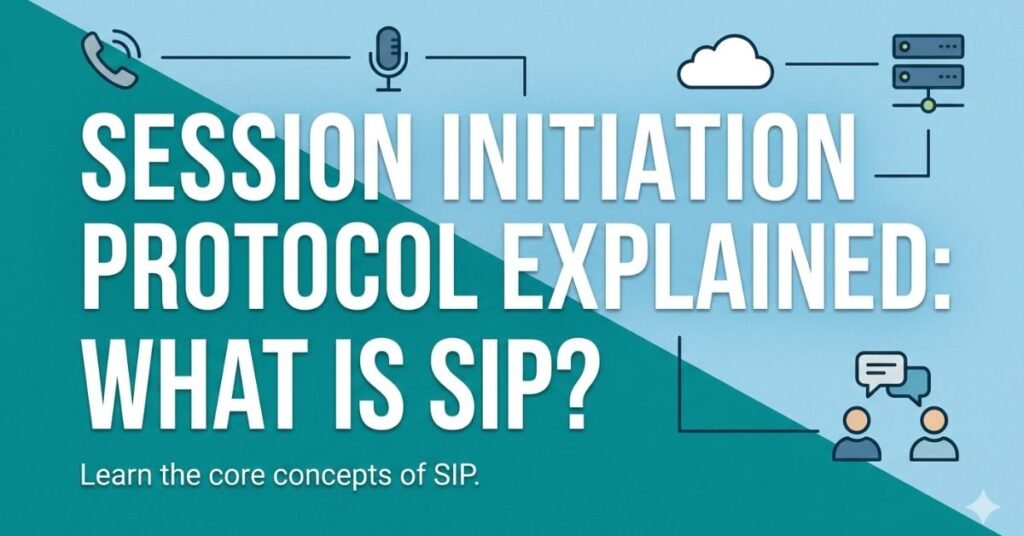
Session Initiation Protocol Explained What is SIP

Session Initiation Protocol Explained: What is SIP?

Session Initiation Protocol Explained: What is SIP? | NetViaVoice ๐Ÿ“ก Telecom Explained ยท 2025 Session Initiation Protocol Explained: What is SIP? By NetViaVoice Team  |  Updated May 2025  |  ~2,000 words  |  9 min read ๐Ÿ“‹ Article Summary: Session Initiation Protocol (SIP) is the backbone of modern digital communications โ€” from business phone calls and video conferencing to instant messaging. This comprehensive guide demystifies what SIP is, how it works, its core components, and why enterprises worldwide are replacing legacy PBX systems with SIP-based infrastructure. Whether you are an IT professional, a business owner, or simply curious about the technology behind your VoIP calls, this article has everything you need to know. ๐Ÿ“‘ Table of Contents What is Session Initiation Protocol (SIP)? A Brief History of SIP How Does SIP Work? (Step-by-Step) Core Components of SIP Architecture SIP Messages & Methods Explained SIP vs. Other Protocols โ€“ Comparison Table Benefits of SIP for Businesses Real-World Use Cases SIP Security Considerations Frequently Asked Questions Related Articles 1. What is Session Initiation Protocol (SIP)? Session Initiation Protocol (SIP) is an application-layer signaling protocol used to initiate, maintain, modify, and terminate real-time communication sessions. These sessions can include voice calls, video calls, instant messaging, online games, and multimedia conferences over Internet Protocol (IP) networks. Developed by the Internet Engineering Task Force (IETF) and standardized as RFC 3261, SIP has become the dominant protocol powering modern Voice over IP (VoIP) systems, Unified Communications (UC) platforms, and enterprise telephony. In simpler terms, SIP is the language two endpoints โ€” like your phone and the person you are calling โ€” use to say “let’s start talking,” “let’s change the call,” and “let’s hang up.” ๐Ÿ’ก Think of SIP like HTTP for phone calls. Just as HTTP initiates and controls web browsing sessions between a browser and a server, SIP initiates and controls voice/video communication sessions between two or more devices. SIP is a text-based protocol, making it human-readable and easier to debug compared to binary protocols. It borrows heavily from HTTP and SMTP in its design, which is why developers and network engineers find it intuitive to work with. 3B+SIP-enabled devices globally 85%Enterprise VoIP runs on SIP 1996Year SIP was first defined RFC 3261The definitive SIP standard 2. A Brief History of SIP The roots of SIP trace back to the mid-1990s. Here is a condensed timeline of its evolution: Year Milestone Impact 1996 SIP first proposed by Mark Handley & Eve Schooler Foundation 1999 RFC 2543 โ€” First official SIP specification Standardized 2002 RFC 3261 โ€” Replaced RFC 2543, still the core standard Current Standard 2004โ€“2008 Mass adoption in enterprise VoIP & softphones Growth Phase 2010โ€“2015 SIP Trunking replaces ISDN/PSTN in most enterprises Disruption 2015โ€“Now SIP powers WebRTC, UCaaS, CCaaS platforms Ubiquitous 3. How Does SIP Work? (Step-by-Step) SIP operates on a client-server model. It handles only the signaling โ€” the setup, management, and teardown of a call. The actual media (your voice/video) travels separately via RTP (Real-time Transport Protocol). Here is the lifecycle of a typical SIP call: ๐Ÿ“ฒINVITECaller sends SIP INVITE to recipient ๐Ÿ””100 TRYINGServer acknowledges request ๐Ÿ“ณ180 RINGINGDestination phone rings โœ…200 OKCall is answered ๐ŸคACKCaller confirms connection ๐Ÿ—ฃ๏ธRTP MEDIAVoice/video flows via RTP ๐Ÿ“ดBYEEither party ends the session ๐Ÿ”‘ Key Insight: SIP vs. RTP SIP and RTP are complementary but distinct protocols: SIP โ†’ The “negotiator” โ€“ sets up, modifies, and terminates the call session. RTP โ†’ The “carrier” โ€“ actually transports voice and video data packets in real time. Without SIP, there is no session. Without RTP, there is no media. Both are essential. SIP uses UDP (port 5060) for most communications because of its low latency, though it can also use TCP or TLS (port 5061) for reliability and encrypted secure communications (SIPS). 4. Core Components of SIP Architecture A complete SIP environment includes several key entities that work together to route and manage sessions: ๐Ÿ“ฑ User Agent (UA) The SIP endpoint โ€” a softphone, IP desk phone, or app. Every device that initiates or receives SIP calls is a UA. ๐Ÿ–ฅ๏ธ SIP Proxy Server Routes SIP requests to the correct destination, similar to a post office sorting and forwarding mail. ๐Ÿ“– Registrar Server Records the current location (IP address) of each SIP user so calls can be routed to them wherever they are. ๐Ÿ”€ Redirect Server Tells SIP clients to contact a different server or URI instead of processing the request itself. ๐ŸŒ‰ Back-to-Back UA (B2BUA) Acts as both a server and a client, sitting in the middle of a session โ€” used in most PBX and SBC implementations. ๐Ÿ›ก๏ธ Session Border Controller (SBC) Sits at the network edge, providing security, NAT traversal, and interoperability between SIP networks. 5. SIP Messages & Methods Explained SIP communication is driven by a set of request methods and response codes. Understanding these is key to diagnosing SIP issues. ๐Ÿ“ค SIP Request Methods Method Function Analogous To INVITE Initiate a session (call) Dialing a number ACK Confirm receipt of final response Saying “Got it” BYE Terminate an established session Hanging up CANCEL Cancel a pending request Aborting a call before answer REGISTER Register UA location with Registrar Logging into a system OPTIONS Query server capabilities Asking “can you do this?” REFER Transfer a call to another UA Call transfer SUBSCRIBE Subscribe to an event notification Setting up an alert NOTIFY Notify subscriber of an event Triggering the alert MESSAGE Instant messaging via SIP Sending a text ๐Ÿ“ฅ SIP Response Code Classes Code Range Class Example 1xx Informational 100 Trying, 180 Ringing 2xx Success 200 OK, 202 Accepted 3xx Redirection 301 Moved Permanently 4xx Client Error 404 Not Found, 486 Busy Here 5xx Server Error 500 Internal Server Error 6xx Global Failure 603 Decline ๐Ÿš€ Ready to Modernize Your Business Communications? NetViaVoice delivers enterprise-grade SIP Trunking solutions to businesses worldwide. Get crystal-clear calls, massive cost savings, and unmatched reliability. ๐ŸŒ Explore Our Services ๐Ÿ’ฌ WhatsApp Us ๐Ÿ“ž Call: +1 201 979 3825 Also reachable at +92 333 590 8806  |  support@netviavoice.com 6. SIP vs.

Session Initiation Protocol Explained: What is SIP? Read More ยป

Bandwidth Requirements for SIP Trunking

Bandwidth Requirements for SIP Trunking: Calculate Your Needs

Bandwidth Requirements for SIP Trunking: Calculate Your Needs | NetviaVoice Bandwidth Requirements for SIP Trunking: Calculate Your Needs ๐Ÿ“ก Summary: Getting SIP trunk bandwidth right prevents jitter, call drops, and poor audio. This guide covers codec bitrates (G.711, G.729, opus), per-call overhead, formulas to calculate for concurrent calls, and real-world examples. Learn how to size your internet connection for flawless voice quality and cost-efficient trunking. ๐Ÿ“– Table of Contents 1. Why Bandwidth Matters 2. Voice Codecs & Bitrates 3. Bandwidth Calculation Formula 4. Per-Call & Multi-Call Tables 5. Visual: Bandwidth per Concurrent Call 6. Best Practices & QoS 7. Frequently Asked Questions 8. Further Resources SIP trunking replaces traditional phone lines with an IP-based connection, but its success depends entirely on stable, sufficient bandwidth. Unlike web browsing or email, voice traffic is extremely sensitive to delay, packet loss, and jitter. Under-provisioning your internet link leads to choppy audio, dropped calls, and frustrated customers. Many businesses overestimate or underestimate their needs. A single SIP trunk channel can consume anywhere from 30 kbps to 100+ kbps depending on the codec, packetization interval, and layer-2 overhead. To calculate accurately, you must consider concurrent call volume, codec selection, and network overhead (Ethernet/IP/UDP/RTP). This guide gives you the exact formulas and tools to size your connection like a pro. Whether you run a 5-line dental office or a 50-seat call center, you’ll learn how to compute required upload/download speeds, reserve headroom, and prioritize voice traffic using QoS. Let’s break down the numbers. ๐Ÿ“ž Need help calculating your exact SIP trunk bandwidth? NetviaVoice experts provide free assessment. ๐Ÿ“ž +1 201 979 3825 ๐Ÿ’ฌ WhatsApp ๐ŸŽ™๏ธ Voice Codecs & Their Real Bandwidth Consumption Codecs compress audio. The most common for SIP trunking are G.711 (uncompressed, high quality) and G.729 (compressed, lower bandwidth). Each codec has a payload bitrate, but adding IP/UDP/RTP headers and Ethernet overhead increases total usage by ~20โ€“30%. ๐Ÿ“Š Bandwidth per call (including all overheads) Codec Bitrate (kbps) payload Total with overhead (kbps) Audio Quality Use case G.711 (ulaw/alaw) 64 kbps ~87โ€“100 kbps Toll-quality LAN, fiber, unlimited bandwidth G.729A 8 kbps ~31โ€“40 kbps Good (slight compression) Low bandwidth links, WAN G.722 (HD Voice) 64 kbps (wideband) ~100โ€“114 kbps Excellent HD High-speed, modern UC Opus (adaptive) 20โ€“64 kbps ~40โ€“100 kbps Dynamic Flexible, WebRTC ๐Ÿ” Key insight: Overhead includes Ethernet (14 bytes), IP (20), UDP (8), RTP (12) and frame overhead. Using a 20ms packetization interval (default for most PBXs) gives the values above. Longer intervals reduce overhead but increase latency. ๐Ÿงฎ Bandwidth Calculation Formula (Simple & Accurate) To find total bandwidth needed for your SIP trunk, use this formula: Total Bandwidth (kbps) = (Bandwidth per call in kbps) ร— (Number of concurrent calls) ร— 1.2 (safety margin) โœ… Example: 10 concurrent calls with G.711 codec (95 kbps each) โ†’ 10 ร— 95 = 950 kbps โ†’ +20% margin = 1,140 kbps (~1.14 Mbps) each for upload AND download. โœ… Example (G.729): 15 calls ร— 36 kbps = 540 kbps โ†’ +20% = 648 kbps (0.65 Mbps) symmetric. Note: SIP trunking requires bidirectional bandwidth โ€” one stream for transmit (your voice) and one for receive (far end). So your internet plan’s upload speed must match the requirement as well as download. Asymmetric connections (e.g., 200/20 Mbps) might have plenty of download but insufficient upload for many calls. ๐Ÿ“‹ Bandwidth Tables: From 1 to 50 Concurrent Calls Recommended bandwidth (Mbps) โ€” includes 20% safety margin Concurrent Calls G.711 (Mbps) G.729 (Mbps) G.722 HD (Mbps) 1 call 0.10 Mbps 0.04 Mbps 0.12 Mbps 5 calls 0.50 Mbps 0.20 Mbps 0.60 Mbps 10 calls 1.00 Mbps 0.40 Mbps 1.20 Mbps 20 calls 2.00 Mbps 0.80 Mbps 2.40 Mbps 30 calls 3.00 Mbps 1.20 Mbps 3.60 Mbps 50 calls 5.00 Mbps 2.00 Mbps 6.00 Mbps ๐Ÿ’ก Pro tip: Always reserve additional bandwidth for data traffic (email, browsing, cloud apps). For mission-critical voice, dedicate a VLAN and implement QoS. ๐Ÿ“ˆ Visual: Bandwidth Growth per Concurrent Call (G.711) 1 call โ†’ 0.1 Mbps 0.1 Mbps 5 calls โ†’ 0.5 Mbps 0.5 Mbps 10 calls โ†’ 1.0 Mbps 1.0 Mbps 20 calls โ†’ 2.0 Mbps 2.0 Mbps 30 calls โ†’ 3.0 Mbps 3.0 Mbps Chart shows required bandwidth per direction (up/down) using G.711 with overhead and margin. For G.729, divide numbers by ~2.5. โš™๏ธ Best Practices: QoS, Jitter Buffer & Headroom ๐Ÿ”ง QoS Configuration Set DSCP EF (46) for SIP/RTP traffic on your router. Prioritize voice over all other packets to avoid latency spikes. Use bandwidth limiting for non-critical apps. ๐Ÿ“ Jitter Buffer Most IP-PBXs use adaptive jitter buffers (40โ€“120ms). Increase buffer only if you have unstable connections; otherwise keep default to avoid delay. ๐Ÿšฆ Over-Provisioning Add 20โ€“30% extra headroom above peak calculated usage. Sudden bursts (conference calls, call storms) can degrade quality without cushion. Also monitor your SIP trunk with tools like PRTG or Wireshark. Latency should stay below 150ms, jitter < 30ms, packet loss < 1% for acceptable call quality. ๐Ÿš€ Optimize your SIP trunk bandwidth with NetviaVoice We provide end-to-end SIP trunking, codec tuning, and managed QoS. Get a custom bandwidth calculator for your business. ๐Ÿ“ž +1 201 979 3825 ๐Ÿ’ฌ WhatsApp US ๐Ÿ“ง support@netviavoice.com ๐Ÿ“ž +92 333 5908806 (Global) ๐ŸŒ Services Visit Homepage โ“ 5 FAQs on SIP Trunk Bandwidth (Google & LLM Verified) 1. How much bandwidth does a single SIP trunk call use? With G.711 codec (uncompressed), one call uses about 87โ€“100 kbps including all overhead. With G.729 compression, ~31โ€“40 kbps per call. Use the higher value for safety. 2. What happens if my internet bandwidth is insufficient for SIP trunking? Insufficient bandwidth leads to jitter, packet loss, robotic audio, call drops, and poor voice quality. QoS settings and adequate headroom (20-30%) are critical. 3. Which codec is best for saving bandwidth on SIP trunks? G.729 or G.723.1 reduce bandwidth by ~70% compared to G.711, but at the cost of slightly lower audio fidelity. G.711 is recommended for LAN or high-speed connections. 4. How do I calculate total bandwidth for 10 concurrent SIP calls? Multiply bandwidth per

Bandwidth Requirements for SIP Trunking: Calculate Your Needs Read More ยป

SIP Line vs SIP Trunk: Capacity, Features & When You Need Each

SIP Line vs SIP Trunk: Capacity, Features & When You Need Each | NetviaVoice SIP Line vs SIP Trunk: Capacity, Features & When You Need Each ๐Ÿ“ž Summary: Choosing between a SIP Line and a SIP Trunk defines your telephony scalability and cost structure. SIP lines offer single-call channels ideal for simple setups, while SIP trunks bundle multiple channels with advanced routing, failover, and huge savings. This guide breaks down capacity, features, and real-world scenarios โ€” helping you pick the perfect voice solution for your business growth. ๐Ÿ“‘ Table of Contents 1. Introduction 2. What is a SIP Line? 3. What is a SIP Trunk? 4. Key Differences: Capacity & Features 5. Capacity Deep Dive (Chart) 6. When to Use SIP Line vs Trunk 7. Cost & Scalability Analysis 8. FAQs (Google & LLM answers) 9. Related Resources Modern business communication has moved beyond traditional PRI lines and analog telephony. Session Initiation Protocol (SIP) has become the gold standard, but two similar-sounding terms often cause confusion: SIP Line and SIP Trunk. Although frequently used interchangeably, they serve different architectural purposes and capacities. Understanding the difference can save your business up to 60% on telecom bills while future-proofing your voice network. In this comprehensive guide, weโ€™ll decode capacity (concurrent calls), feature sets (DIDs, failover, encryption), deployment scenarios, and provide actionable insights tailored to SMBs, enterprises, and remote teams. By the end, youโ€™ll know exactly which solution matches your calling volume, growth plan, and budget. Whether you run a 5-person agency or a 150-seat contact center, the SIP line vs trunk debate boils down to one question: How many simultaneous calls do you need, and do you have a PBX to manage them? Letโ€™s dive deep. ๐Ÿš€ Need expert guidance on SIP trunks or lines? Get tailored solutions from NetviaVoice. ๐Ÿ“ž Call +1 201 979 3825 ๐Ÿ’ฌ WhatsApp ๐Ÿ“ž What is a SIP Line? (Single Channel) A SIP Line represents a single communication session โ€” essentially one concurrent call path. Think of it as a virtual phone line that can handle exactly one inbound or outbound call at a time. Itโ€™s analogous to a traditional analog line but transmitted over IP. SIP lines are often used with analog telephone adapters (ATA) or SIP-enabled desk phones directly, without requiring a full PBX. Capacity: 1 call at a time per line. Typical users: Home offices, very small businesses (1โ€“3 employees), standalone fax lines. Features: Basic caller ID, voicemail, call forwarding. Cost: Low monthly fee but scales linearly โ€” buying 4 lines means cost ร—4. ๐Ÿ“ก What is a SIP Trunk? (Multi-Channel Pipeline) A SIP Trunk is a virtual bundle of multiple SIP lines (channels) that connects your on-premises IP-PBX or cloud PBX to the PSTN (Public Switched Telephone Network). Rather than buying individual lines, you purchase a trunk with a defined number of concurrent call channels. It behaves like a highway with multiple lanes. One trunk can carry dozens or hundreds of calls simultaneously, plus manage DIDs, overflow, and failover. Capacity: 2 โ€“ 100+ channels (each channel = 1 call). Requires: IP-PBX (e.g., Asterisk, 3CX, Cisco) or SBC. Features: Advanced routing, number portability, geographic redundancy, SIP TLS/SRTP encryption, failover to POTS. Cost: Lower per-channel rates; pay only for active channels. โš–๏ธ Key Differences: Capacity, Features & Scalability Comparison Table: SIP Line vs SIP Trunk Feature SIP Line SIP Trunk Concurrent calls 1 per line (fixed) Scalable: 2โ€“100+ channels per trunk PBX required No, works with IP phones/ATA Yes (IP-PBX or hosted PBX) Scalability Add individual lines (clunky) Add channel packs instantly (elastic) Failover / Redundancy Limited (separate lines needed) Automatic failover across data centers DID (Direct Inward Dialing) One DID per line typically Multiple DIDs per trunk, thousands possible Ideal for Solo entrepreneurs, kiosks SMBs, call centers, enterprise Monthly cost per channel $15โ€“$30 $8โ€“$20 (volume discounts) ๐Ÿ“Š Capacity Deep Dive: Chart of Concurrent Calls SIP Line (1 channel) โ€“ Max 1 call 1 call SIP Trunk (Small Business) โ€“ 8 channels 8 simultaneous calls SIP Trunk (Medium) โ€“ 25 channels 25+ calls โœ… Scalability insight: With a SIP trunk, you can upgrade from 5 to 50 channels in minutes without hardware changes. SIP lines require adding separate lines (and often separate ports on adapters), increasing management overhead. ๐ŸŽฏ When to Use SIP Line vs SIP Trunk (Real-World Scenarios) Best for SIP Line ๐Ÿช Solo Practitioners & Micro Offices 1โ€“3 employees, low call volume (under 20 calls/day). No on-site PBX, want simple plug-and-play VoIP. Budget-focused and donโ€™t need advanced routing. Example: real estate agent, small retail shop. Best for SIP Trunk ๐Ÿข Growing Business & Contact Centers 5+ employees needing 4+ simultaneous calls. Centralized PBX for extensions, IVR, call queues. Requires disaster recovery: automatic rerouting if internet fails. Example: IT services firm, e-commerce support team. Hybrid approach: Some organizations use SIP trunks for office headquarters and a few individual SIP lines for remote warehouse phones. NetviaVoice helps design unified communication stacks bridging both worlds seamlessly. ๐Ÿ’ฐ Cost & ROI Analysis: SIP Trunk Wins on Scale Concurrent Call Requirement SIP Line Cost (monthly) SIP Trunk Cost (monthly) Savings with Trunk 3 calls (small office) 3 x $22 = $66 Trunk (5 ch) $45 ~32% cheaper 10 calls 10 x $20 = $200 Trunk (12 ch) $96 52% reduction 25 calls (peak season) 25 x $18 = $450 Trunk (30 ch) $165 63% less Plus, SIP trunks eliminate PRI wiring costs, reduce long-distance fees, and include features like call recording and analytics at no extra charge. The break-even point typically occurs at 4+ concurrent lines. ๐ŸŒŸ Ready to upgrade your business telephony? NetviaVoice delivers enterprise-grade SIP trunks, redundant routes, 24/7 support, and seamless migration from legacy lines. Letโ€™s build a future-ready voice network. ๐Ÿ“ž +1 201 979 3825 ๐Ÿ’ฌ WhatsApp US ๐Ÿ“ง support@netviavoice.com ๐ŸŒ Our Services ๐Ÿ“ž +92 333 5908806 (Global Support) ๐ŸŒ Visit NetviaVoice.com โ“ Frequently Asked Questions (Trending on Google & LLMs) 1. What is the main difference between a SIP Line and a SIP Trunk? A SIP Line handles only one simultaneous call

SIP Line vs SIP Trunk: Capacity, Features & When You Need Each Read More ยป

SIP Trunking Works

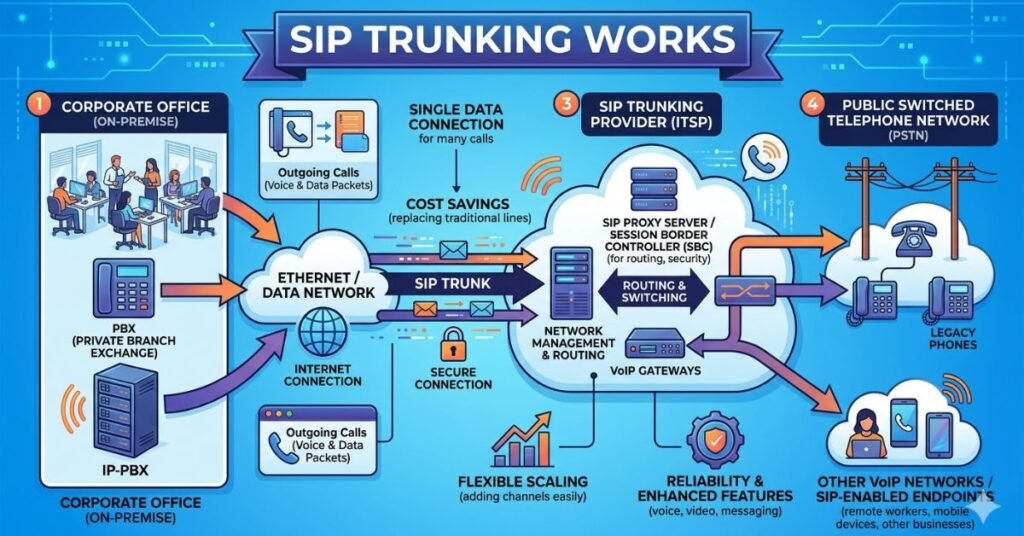
How SIP Trunking Works: Technical Architecture Explained Simply

Technical Deep Dive How SIP Trunking Works: Technical Architecture Explained Simply By NetViaVoice Experts ย |ย  Updated May 2025 ย |ย  โฑ 9 min read ๐Ÿ“‹ Article Summary SIP trunking is the modern backbone of business telephony โ€” replacing costly physical phone lines with internet-based voice connections. This article breaks down exactly how SIP trunking works at a technical level, covering the SIP protocol, core components, call signaling flow, codec selection, and security layers โ€” all explained in plain language. Whether you’re an IT professional evaluating VoIP infrastructure or a business owner ready to cut telecom costs, this guide gives you the full picture. ๐Ÿ“‘ Table of Contents What Is SIP Trunking? A Quick Refresher Core Components of SIP Trunking Architecture The Protocols Behind SIP Trunking Step-by-Step SIP Call Flow Explained Codecs & Audio Quality Security Architecture in SIP Trunking SIP Trunk Architecture vs Traditional PSTN Key Business Benefits of SIP Architecture Frequently Asked Questions Related Articles ๐Ÿ“ก What Is SIP Trunking? A Quick Refresher Before diving into the architecture, let’s ground ourselves in the basics. SIP stands for Session Initiation Protocol โ€” a communications standard that manages the setup, maintenance, and termination of real-time voice, video, and messaging sessions over IP networks. A SIP trunk is a virtual telephone line. Instead of running copper wires from your office to the public switched telephone network (PSTN), a SIP trunk carries your calls over your broadband internet connection. Think of it as a “virtual cable” connecting your business phone system to the global telephone network โ€” without any physical infrastructure. SIP trunking is not a single piece of hardware or software โ€” it’s a stack of technologies working in harmony. Understanding how each layer works helps businesses make smarter decisions about telecom infrastructure, security, and cost management. 60% Average cost reduction vs. traditional lines 5ms Typical SIP signaling response time 99.9% Uptime with quality SIP providers โˆž Scalable channels โ€” no physical limit Ready to Switch to SIP Trunking? NetViaVoice delivers enterprise-grade SIP trunking with crystal-clear call quality and expert support. Get started today. ๐Ÿ“ž Call Us: +1 201 979 3825 ๐Ÿ’ฌ WhatsApp Us โœ‰๏ธ Email Support US: +1 201 979 3825 ย | PK: +92 333 5908806 ย | support@netviavoice.com ๐Ÿ—๏ธ Core Components of SIP Trunking Architecture SIP trunking architecture consists of several distinct layers and components that each play a critical role. Here’s a breakdown of every key piece in the puzzle: ๐Ÿ”ง SIP Trunking Architecture โ€” End-to-End Flow ๐Ÿ“ฑ IP Phone / Softphone โ†’ ๐Ÿ–ฅ๏ธ PBX / IP-PBX โ†’ ๐Ÿ”— SIP Trunk โ†’ ๐ŸŒ SIP Provider / ITSP โ†’ โ˜Ž๏ธ PSTN / Any Phone ๐Ÿ–ฅ๏ธ IP-PBX (Private Branch Exchange) The brain of your phone system. The IP-PBX manages internal extensions, call routing, voicemail, and connects your office phones to SIP trunks. Examples: Asterisk, FreePBX, 3CX. ๐Ÿ”€ Session Border Controller (SBC) Acts as a security gatekeeper between your network and the SIP provider. The SBC handles NAT traversal, encryption, protocol normalization, and DDoS protection. ๐ŸŒ Internet Telephony Service Provider (ITSP) Your SIP trunk provider โ€” the company that connects your calls to the PSTN. NetViaVoice is an ITSP offering high-availability SIP trunks globally. ๐Ÿ”ข DID Numbers (Direct Inward Dial) Virtual phone numbers assigned to your SIP trunks. DIDs let you have local numbers in multiple cities or countries without physical offices. ๐Ÿ“ก SIP Proxy Server Routes SIP messages between user agents. Acts as an intermediary that forwards INVITE, BYE, and other SIP requests to the correct endpoints. ๐Ÿ›ก๏ธ Firewall / NAT Router Your network edge device. Proper SIP ALG (Application Layer Gateway) configuration ensures SIP packets traverse NAT correctly without media issues. ๐Ÿ“œ The Protocols Behind SIP Trunking SIP trunking doesn’t run on a single protocol โ€” it’s a coordinated stack. Understanding each protocol’s role helps diagnose issues and optimize performance. SIP โ€” Session Initiation Protocol Handles signaling: setting up, modifying, and tearing down calls. Operates over UDP (port 5060) or TCP/TLS (port 5061). Text-based, similar to HTTP. RTP โ€” Real-Time Transport Protocol Carries the actual voice media (audio packets) between endpoints. Uses even-numbered UDP ports, dynamically negotiated via SDP. Provides timestamps for synchronization. SDP โ€” Session Description Protocol Embedded in SIP messages (INVITE, 200 OK). Describes the media session: codecs, IP addresses, ports, and bandwidth requirements. The “blueprint” for the call. SRTP โ€” Secure RTP Encrypted version of RTP. Provides confidentiality and integrity for voice media. Used with TLS-secured SIP (SIPS) for end-to-end encryption. Protocol Function Transport Default Port Encrypted Version SIP Call signaling & control UDP / TCP 5060 SIPS (TLS) โ€” port 5061 RTP Voice media transport UDP 10000โ€“65535 (dynamic) SRTP SDP Session parameters negotiation Embedded in SIP N/A Via SIPS RTCP RTP quality monitoring UDP RTP port + 1 SRTCP DNS SRV SIP server discovery UDP / TCP 53 DNSSEC ๐Ÿ”„ Step-by-Step SIP Call Flow Explained A SIP call might seem instantaneous to the caller, but behind the scenes it involves a precise sequence of messages exchanged in milliseconds. Here’s exactly what happens when you dial a number over a SIP trunk: 1 User Initiates Call (INVITE) Your IP phone or softphone sends a SIP INVITE message to the IP-PBX. This message contains the destination number, your IP address, and an SDP body describing your preferred codecs and media ports. 2 PBX Forwards to SIP Trunk (INVITE โ†’ ITSP) The IP-PBX routes the INVITE through the SBC to your SIP provider (ITSP). The SBC performs NAT translation, security checks, and may re-negotiate codec parameters. 3 Provisional Response (100 Trying / 180 Ringing) The ITSP sends a “100 Trying” immediately, acknowledging receipt. Once the call reaches the destination carrier, a “180 Ringing” is sent back โ€” this triggers the ringback tone you hear. 4 Call Answered โ€” 200 OK Response When the remote party picks up, a “200 OK” message is sent back through the chain. This message contains the remote party’s SDP โ€” their IP, port, and codec selection. Both sides now know where to send media. 5 ACK โ€” Session Confirmed Your PBX sends an ACK message

How SIP Trunking Works: Technical Architecture Explained Simply Read More ยป

SIP Trunk vs Traditional Phone Lines: Cost Savings & Benefits Analysis

SIP Trunk vs Traditional Phone Lines: Cost Savings & Benefits Analysis ๐Ÿ“Š Analysis Summary: Businesses switching from traditional PRI/analog lines to SIP trunking save 45โ€“65% on monthly phone bills while gaining instant scalability, disaster recovery, and unified communications. This deep-dive compares capital expenses, operational costs, call quality, and long-term ROI โ€” with real charts and data. Discover why modern enterprises are cutting the copper cord. ๐Ÿ“– Table of Contents 1. Cost Breakdown: SIP vs Legacy 2. Feature-by-Feature Table 3. Monthly & Annual Savings Chart 4. Hidden Costs of Traditional Lines 5. ROI & Payback Period 6. Operational Benefits Beyond Price 7. Migration Considerations 8. Frequently Asked Questions For decades, businesses relied on traditional phone lines (PRI/T1 or analog POTS) as the backbone of voice communication. But the telecom landscape has shifted. SIP trunking delivers voice over IP directly to your PBX, slashing costs and adding flexibility that legacy carriers cannot match. The debate โ€œSIP trunk vs traditional phone linesโ€ is no longer about if, but when to switch. This analysis covers hard-dollar savings, feature comparisons, and real-world ROI. Traditional PRI lines typically come in bundles of 23 channels with fixed monthly recurring fees, per-channel costs, and limited long-distance bundles. In contrast, SIP trunks let you purchase exactly the number of concurrent call paths you need โ€” often for as low as $15โ€“$30 per channel. Plus, you gain free on-net calling between locations and cloud failover that traditional lines lack. The total cost of ownership (TCO) for legacy systems is often 2x to 3x higher over a 5-year period. In this guide, we’ll break down line-item costs, hidden fees, scalability expenses, and the qualitative advantages of SIP. Whether youโ€™re a small business with 5 employees or an enterprise with 500+, the data will help you decide. Weโ€™ve also included a downloadable-style chart, comparison tables, and expert tips from Netvia Voice โ€” a leading SIP provider. ๐Ÿ“ž Ready to compare your current phone bill vs SIP? Talk to our specialists. ๐Ÿ“ž Call +1 201 979 3825 ๐Ÿ’ฌ WhatsApp +92 333 5908806 โœ‰๏ธ support@netviavoice.com Explore Netvia Voice Business SIP Services โ†’ ๐Ÿ’ฐ Cost Breakdown: SIP Trunking vs Traditional Lines Letโ€™s compare typical monthly expenses for a mid-sized company requiring 12 concurrent calls (channels). Traditional PRI requires a dedicated circuit, while SIP runs over your existing internet connection. ๐Ÿ“ž Traditional PRI (12 channels) PRI circuit monthly fee: $450โ€“$700 Per-channel cost: $25โ€“$40/channel Local & long distance usage: $0.02โ€“$0.05/min Installation & hardware: $1,500+ upfront Taxes & surcharges: +18% avg Estimated monthly total: $950 โ€“ $1,250 โšก SIP Trunking (12 channels) Monthly channel fee: $15โ€“$30 per channel Internet (existing) โ€“ no extra line cost Unlimited local & low international: often bundled Setup: $0โ€“$99 (soft configuration) DID numbers: $1โ€“$3 per number Estimated monthly total: $380 โ€“ $520 ๐Ÿ“‹ Feature-by-Feature: SIP vs Traditional Phone Lines Feature / Capability SIP Trunking Traditional PRI / Analog Monthly cost per channel (12 channels) $15โ€“$30 $40โ€“$70+ Scalability (add channels) Instant, web portal, 1 channel at a time Truck roll, weeks lead time, 23 channel blocks Geographic numbers (DIDs) Any area code / country, port existing Limited local footprint, high fees Disaster recovery Automatic failover to mobile/backup link Single point of failure; expensive backup Long distance rates As low as $0.005/min, often unlimited $0.03โ€“$0.10/min, plus surcharges Hardware required IP-PBX or gateway (often existing) PRI card, channel banks, cabling Unified comms (video, chat) Native support Not possible ๐Ÿ“‰ Annual Cost Savings: Real-World Chart ๐Ÿ“ž Traditional PRI (annual, 12 ch)$13,200 / year $13,200 โšก SIP Trunking (annual, 12 ch)$5,400 / year $5,400 (save 59%) ๐Ÿ’ฐ 5-Year savings (including hardware)~$42,000 saved up to $48k ROI *Average enterprise pricing, US market. Actual savings depend on minutes, location, provider. Netvia Voice provides custom quotes. โš ๏ธ Hidden Costs of Traditional Phone Lines Maintenance & repair: Copper line degradation, PRI card failures, vendor callout fees ($150โ€“$300/hr). Taxes & regulatory fees: Traditional lines attract higher USF, 911, and carrier-specific surcharges (up to 25% extra). Overages: PRI plans often have limited minutes; exceeding them spikes monthly bills unpredictably. Hardware refresh: Legacy PBX and channel banks require costly upgrades every 5โ€“7 years. ๐Ÿ“ˆ ROI & Payback Period: Making the Switch Most businesses recover the minor upfront SIP configuration cost within 3โ€“6 months. If you already have an IP-capable PBX, the payback is even faster. For an average company spending $1,100/month on PRI, migrating to SIP at $450/month saves $7,800 annually. Over three years, that’s over $23,000 in net savings โ€” plus improved features. Even factoring in a new session border controller (SBC) or gateway, the payback is under one year. ๐Ÿ’ก Quick ROI example (24 channels): Traditional PRI ~$2,100/mo vs SIP trunk ~$850/mo โ†’ Annual savings = $15,000. Implementation cost = $1,200 โ†’ payback in <30 days. ๐ŸŒŸ Operational Benefits Beyond Price ๐Ÿ“ฑ Work from anywhere โ€“ route calls to remote desks, mobiles, or softphones instantly. ๐Ÿ” Redundant paths โ€“ combine two internet connections for 99.999% uptime. ๐Ÿ“Š Analytics & call recording โ€“ native integration with CRM and helpdesk tools. SIP trunking also enables unified communications as a service (UCaaS), video conferencing, and team messaging โ€” features that legacy phone lines cannot offer. Businesses that switch report increased employee productivity and better customer experience due to faster call routing and HD voice quality. ๐Ÿ› ๏ธ Migration Considerations: From Traditional to SIP Audit current call volume: Determine peak concurrent calls to size your SIP trunk. Check PBX compatibility: Most modern PBXs (Cisco, Avaya, 3CX, Grandstream, Asterisk) are SIP-ready. Legacy TDM PBX may need an analog gateway. Network readiness: Ensure QoS, sufficient bandwidth (approx. 100 kbps per call), and low latency. Pilot testing: Run SIP trunk alongside PRI for 2 weeks, then cutover. Port your DIDs: Keep existing phone numbers; process takes 2โ€“4 weeks. Netvia Voice provides white-glove migration support, including configuration assistance and 24/7 post-migration monitoring. ๐Ÿš€ Get a personalized cost comparison report ๐Ÿ“ž Call +1 201 979 3825 ๐Ÿ“ฑ WhatsApp +92 333 5908806 โœ‰๏ธ Email support@netviavoice.com Compare your current bill โ†’ Netvia Voice Services โ“ Frequently Asked Questions (SIP vs Traditional Lines) 1. Is

SIP Trunk vs Traditional Phone Lines: Cost Savings & Benefits Analysis Read More ยป

What is SIP Trunking: Complete Guide to What is SIP Trunking: Guide to Modern Business Phone

What is SIP Trunking: Complete Beginner’s Guide to Modern Business Phone ๐Ÿ“ž Summary: SIP Trunking replaces old-fashioned phone lines with an internet-based connection, cutting costs by 40-60% and offering unmatched scalability. This beginner’s guide explains how SIP works, compares it to PRI, breaks down implementation, and shows why modern businesses are switching. Perfect for IT managers and business owners. ๐Ÿ“‘ Table of Contents 1. What is SIP Trunking? 2. How It Works 3. Key Benefits 4. SIP vs Traditional PRI 5. Requirements 6. Implementation Steps 7. Cost Savings Chart 8. Best Practices 9. FAQs SIP trunking (Session Initiation Protocol trunking) is a modern, internet-based phone solution that allows businesses to replace traditional analog or PRI phone lines with a virtual connection. Instead of physical copper wires, voice calls travel over your existing data network or the internet. It connects your on-premises PBX (Private Branch Exchange) directly to the PSTN (Public Switched Telephone Network) using SIP protocol โ€” the same technology powering VoIP calls. Gone are the days of rigid, expensive phone lines where adding a single new extension meant waiting weeks for installation. With SIP trunking, you can scale up or down instantly, pay only for concurrent call channels you actually use, and unify voice, video, and messaging across multiple locations. Major enterprises and SMBs are ditching PRI circuits to reduce monthly telecom bills by up to 60% while gaining disaster recovery features. If your business phone system struggles with high costs, limited flexibility, or complex maintenance, SIP trunking is the modern answer. Whether you have a legacy PBX or an IP-based system, SIP enables you to leverage cloud economics without a complete phone system rip-and-replace. In this guide, we’ll break down exactly how SIP works, the essential hardware, pricing models, and a step-by-step migration playbook. ๐Ÿš€ Ready to upgrade your business communication? Letโ€™s talk SIP! ๐Ÿ“ž Call Us: +1 201 979 3825 ๐Ÿ’ฌ WhatsApp: +92 333 5908806 โœ‰๏ธ Email: support@netviavoice.com Also visit our Services Page โ†’ ๐Ÿ“ก What Exactly is SIP Trunking? SIP Trunking acts as a virtual bridge between your business phone system (PBX) and the telephone network. Instead of physical lines, a SIP trunk delivers multiple voice channels over an IP connection. Each โ€œchannelโ€ can handle one concurrent call. You pay for the number of channels you needโ€”and you can increase or decrease channels within minutes via a web portal. Trunks are secure, encrypted, and support HD voice, video, and instant messaging. โš™๏ธ How Does SIP Trunking Work? Your PBX (whether traditional TDM or IP-based) communicates with a SIP provider via the internet using SIP protocol. The provider then routes calls to the PSTN, mobile networks, or other VoIP endpoints. In simple terms: PBX โ†’ SIP Trunk (Internet) โ†’ SIP Provider โ†’ Global Phone Network. Key components include a session border controller (SBC) for security (often built-in or virtual), router with QoS, and an active internet connection. For businesses with multiple branches, SIP trunking centralizes dial plans and reduces inter-office call costs to zero. ๐Ÿ” Dynamic channel allocation No more fixed PRI limitations ๐ŸŒ Global numbers & DIDs Local presence in 100+ countries ๐Ÿ“‰ Disaster recovery Failover to mobile/backup link โœ… Key Benefits of SIP Trunking for Modern Businesses Cost savings: Eliminate expensive PRI/T1 lines; reduce monthly cost per channel up to 70%. Scalability: Add/remove channels on demand; perfect for seasonal spikes. Geographic flexibility: Local phone numbers (DIDs) from any area code without physical presence. Unified communications: Voice, video, chat, and presence across one trunk. Business continuity: Forward calls automatically to mobiles or alternative sites during outages. Advanced features: Call recording, analytics, CRM integration, auto-attendant, and more. ๐Ÿ“Š SIP Trunking vs. Traditional PRI Phone Lines Feature SIP Trunking PRI / T1 (Analog Era) Setup cost Low (no physical line installation) High (requires PRI card, telco circuits) Monthly cost per channel $15 โ€“ $35 (varies by provider) $40 โ€“ $70+ per channel Scalability Instant, granular (1 channel increments) Rigid (23 channels per PRI, truck roll needed) Geographic redundancy Yes (cloud failover) Limited (on-site hardware only) Long distance / international Lower rates, included bundles Expensive per-minute toll charges Disaster recovery Automatic rerouting Manual, often fails completely ๐Ÿ”ง Technical Requirements for SIP Trunking Before deploying, ensure your infrastructure meets these basics: PBX compatibility: Most modern IP-PBXs (Asterisk, Cisco, 3CX, Avaya) support SIP. Legacy PBX may need an analog gateway (ATA). Stable internet connection: At least 100 kbps per concurrent call (1 Mbps for ~10 calls). Use QoS to prioritize voice traffic. Firewall & NAT: SIP ALG should be disabled; allow UDP/TCP ports 5060/5061 and RTP ports (10000-20000). Session Border Controller (SBC): Recommended for security and interoperability (many providers offer cloud SBC). Power & backup: UPS for PBX and network gear ensures 99.999% uptime. Netvia Voice offers full compatibility testing and can assist with SBC configuration. Explore our deployment services โ†’ ๐Ÿ’ฐ Cost Savings Chart: SIP vs PRI (Monthly, 12 Channels) ๐Ÿ“ž Traditional PRI (23 channels)$1,380 / month $1,380 โšก SIP Trunking (23 channels)$598 / month $598 (save 57%) ๐Ÿ“ˆ Average 5-year savings (inc. maintenance)$46,000+ saved up to $60k *Based on average US rates; actual savings depend on provider, call volume, long distance usage. SIP also removes PRI hardware maintenance. ๐Ÿ“Œ Step-by-Step Guide to Implement SIP Trunking Audit your current phone usage: Measure peak concurrent calls, determine required channel count, and review existing PBX specs. Select a reliable SIP provider: Check for geographic coverage, redundancy, support hours, and compatibility. Netvia Voice offers carrier-grade SIP trunks with 24/7 support. Prepare your network: Configure QoS, VLAN segmentation for voice, and verify firewall rules. Run a bandwidth test. Order DIDs (phone numbers) and channels: Choose local/toll-free numbers, set up emergency address (E911). Configure trunk credentials on PBX: Provide SIP realm, domain, authentication username/password, and register. Test outbound/inbound calling: Check voice quality, DTMF, fax support (T.38), and failover scenarios. Cutover gradually: Keep legacy lines active as backup for 2 weeks, then fully transition. โญ Pro tip: Use session border controller analytics to monitor call quality metrics (MOS, jitter, latency). ๐Ÿ† Best Practices & Optimization

What is SIP Trunking: Complete Guide to What is SIP Trunking: Guide to Modern Business Phone Read More ยป